Sunday, February 26, 2012

Site-Controlled Application of Electric Potential on a Conducting Polymer “Canvas”


Yutaka Ishiguro, Shinsuke Inagi*, and Toshio Fuchigami*
Department of Electronic Chemistry, Tokyo Institute of Technology, 4259 Nagatsuta, Midori-ku, Yokohama 226-8502, Japan
J. Am. Chem. Soc., Article ASAP
DOI: 10.1021/ja211774z
Publication Date (Web): February 21, 2012
Copyright © 2012 American Chemical Society
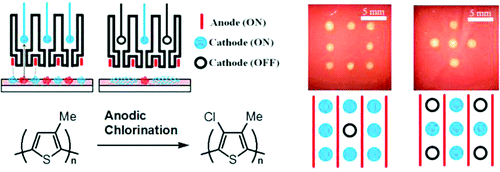

A novel patterning method for conducting polymer films was successfully demonstrated using the concept of bipolar electrochemistry. The local application of an anodic potential to poly(3-methylthiophene) (PMT) and poly(3,4-ethylenedioxythiophene) (PEDOT) on a bipolar electrode (BPE) realized local electrochemical doping and reaction depending on the supporting salt used. The potential applied on the BPE was measured and corresponded well to the patterns. The array-type driving electrode system was able to draw complex patterns in a site-controlled manner.

Collective Conformations of DNA Polymers Assembled on Surface Density Gradients


Gabriel Shemer, Yahel Atsmon, Eyal Karzbrun, and Roy H. Bar-Ziv*
Department of Materials and Interfaces, Weizmann Institute of Science, Rehovot 76100, Israel
J. Am. Chem. Soc., Article ASAP
DOI: 10.1021/ja2106543
Publication Date (Web): February 15, 2012
Copyright © 2012 American Chemical Society


To study dense double-stranded DNA (dsDNA) polymer phases, we fabricated continuous density gradients of binding sites for assembly on a photochemical interface and measured both dsDNA occupancy and extension using evanescent fluorescence. Despite the abundance of available binding sites, the dsDNA density saturates after occupation of only a fraction of the available sites along the gradient. The spatial position at which the density saturates marks the onset of collective stretching of dsDNA, a direct manifestation of balancing entropic and excluded-volume interactions. The methodology presented here offers a new means to investigate dense dsDNA compartments.

Synthesis of Monodisperse, Covalently Cross-Linked, Degradable “Smart” Microgels Using Microfluidics


  1. Leah R. B. Kesselman1
  2. Siawash Shinwary2
  3. P. Ravi Selvaganapathy2
  4. Todd Hoare1,*
Article first published online: 22 FEB 2012
DOI: 10.1002/smll.201102113

The development of a robust method for the synthesis of highly monodisperse microgels cross-linked with degradable covalent bonds offers the potential for fabricating microgels with the highly controllable porosities, cell interactions, and degradation half-lives required for biomedical applications. A microfluidic chip is designed that enables the on-chip mixing and emulsification of two reactive polymer solutions (hydrazide and aldehyde-functionalized carbohydrates) to form monodisperse, hydrazone cross-linked microgels in the size range of ≈40–100 μm. The device can be run continuously for at least 30 h without a significant drift in particle size. The resulting microgels have a homogeneous bulk composition and can swell and deswell as the solvent conditions change in predictable ways based on the chemistry of the reactive polymers used, thereby enabling improved control over both the chemistry and morphology of the resulting microgels relative to other reported approaches. The in situ gelation chemistry used facilitates rapid microgel formation within the droplets without requiring the use of UV light or heating to initiate polymerization, thus making this approach of particular potential utility in cell encapsulation or drug delivery (as demonstrated).

Sunday, February 19, 2012

Nanoimprint Lithography: A Polyferroplatinyne Precursor for the Rapid Fabrication of L10-FePt-type Bit Patterned Media by Nanoimprint Lithography


  1. Qingchen Dong1
  2. Guijun Li2
  3. Cheuk-Lam Ho1
  4. Mahtab Faisal3
  5. Chi-Wah Leung4,
  6. Philip Wing-Tat Pong2,*
  7. Kun Liu5
  8. Ben-Zhong Tang3
  9. Ian Manners6,*
  10. Wai-Yeung Wong1,*
Article first published online: 14 FEB 2012
DOI: 10.1002/adma.201290034
W.-T. Pong, I. Manners, W.-Y. Wong, and co-workers report the simple and rapid fabrication of patterned L10-FePt alloy nanoparticles from a solution-processable bimetallic polyferroplatinyne polymer precursor. This approach holds great promise for fabricating L10-FePt-type bit-patterned media using high-throughput nanoimprint lithography, followed by controlled pyrolysis of the nanopatterned polymer. Each dot in the asgenerated FePt-containing nanodot array is magnetic, which can serve as a good platform for future ultrahigh-density perpen-dicular magnetic data recording systems.

Self-Assembled Flexible Microlasers


  1. Van Duong Ta
  2. Rui Chen
  3. Han Dong Sun*
Article first published online: 10 FEB 2012
DOI: 10.1002/adma.201103409


Hemispherical microresonators with tunable sizes are obtained based on the hydrophobic effect on distributed Bragg reflectors. Under optical excitation, whispering gallery mode lasing is observed from the dye-doped microresonators at room temperature. The results indicate the potential application of the flexible microresonators in photonic integrated circuits.

A General Approach to Synthesize Asymmetric Hybrid Nanoparticles by Interfacial Reactions


Jie He, Maria Teresa Perez, Peng Zhang, Yijing Liu, Taarika Babu, Jinlong Gong*, and Zhihong Nie*
 Department of Chemistry and Biochemistry, University of Maryland, College Park, Maryland 20742, United States
 Key Laboratory for Green Chemical Technology of Ministry of Education, School of Chemical Engineering and Technology, Tianjin University, Tianjin 300072, China
J. Am. Chem. Soc., Article ASAP
DOI: 10.1021/ja210844h
Publication Date (Web): February 9, 2012
Copyright © 2012 American Chemical Society


Asymmetric multicomponent nanoparticles (AMNPs) offer new opportunities for new-generation materials with improved or new synergetic properties not found in their individual components. There is, however, an urgent need for a synthetic strategy capable of preparing hybrid AMNPs with fine-tuned structural and compositional complexities. Herein, we report a new paradigm for the controllable synthesis of polymer/metal AMNPs with well-controlled size, shape, composition, and morphology by utilizing interfacial polymerization. The hybrid AMNPs display a new level of structural–architectural sophistication, such as controlled domain size and the number of each component of AMNPs. The approach is simple, versatile, cost-effective, and scalable for synthesizing large quantities of AMNPs. Our method may pave a new route to the design and synthesis of advanced breeds of building blocks for functional materials and devices.

Zipping Effect on Omniphobic Surfaces for Controlled Deposition of Minute Amounts of Fluid or Colloids


  1. Renaud Dufour1,2
  2. Philippe Brunet3,
  3. Maxime Harnois1
  4. Rabah Boukherroub2,
  5. Vincent Thomy1
  6. Vincent Senez1,*
Article first published online: 16 FEB 2012
DOI: 10.1002/smll.201101895


When a drop sits on a highly liquid-repellent surface (super-hydrophobic or super-omniphobic) made of periodic micrometer-sized posts, its contact-line can recede with very weak mechanical retention providing that the liquid stays on top of the microsized posts. Occurring in both sliding and evaporation processes, the achievement of low-contact-angle hysteresis (low retention) is required for discrete microfluidic applications involving liquid motion or self-cleaning; however, careful examination shows that during receding, a minute amount of liquid is left on top of the posts lying at the receding edge of the drop. For the first time, the heterogeneities of these deposits along the drop-receding contact-line are underlined. Both nonvolatile liquid and particle-laden water are used to quantitatively characterize what rules the volume distribution of deposited liquid. The experiments suggest that the dynamics of the liquid de-pinning cascade is likely to select the volume left on a specific post, involving the pinch-off and detachment of a liquid bridge. In an applied prospective, this phenomenon dismisses such surfaces for self-cleaning purposes, but offers an original way to deposit controlled amounts of liquid and (bio)-particles at well-targeted locations.